

Want to stay up to date?
Subscribe to our newsletter

You usually do not see it. No checklists on the table. No labels in sight. No red stickers on a workstation that will soon be used day and night. And yet, this is where everything starts at CREON. Before a workstation becomes part of a control room, it has already been inspected, reviewed and checked several times. By people who know where things can go wrong and why that is not an option in a 24/7 environment.
At CREON, in control is not a single moment. It is a continuous process. From incoming inspection to service visits. With attention to details you only notice when they are missing.
As soon as components arrive, the first quality check starts. Aluminium profiles, worktops, acoustic panels and 24/7 task chairs are inspected one by one, based on drawings and bills of materials.
“Everything that comes in is checked against the drawings and the delivery note,” Allround Mechanic Peter van Dijk explains. “If it is not right, it does not move on.”
Metal parts are checked for imperfections, panels for bonding and finish. Task chairs are inspected for appearance, materials and functionality. Each product has its own quality criteria. If something does not meet the standard, it is clearly marked. Technicians then assess whether the quality is acceptable. CREON decides whether a component is returned to the supplier or resolved in another way.
“It is frustrating when a product has a flaw, especially if it is visible,” says mechanic colleague Anouschka Terloo. “We promise high quality. That means we have to be consistent.” Suppliers are actively involved in this process as well. Some work with predefined quality checklists. In this way, quality becomes a shared responsibility.
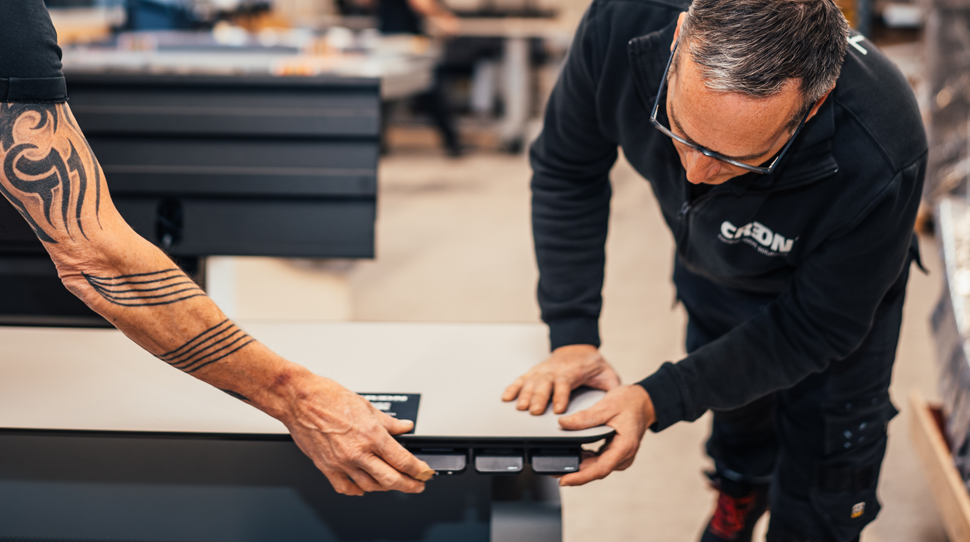

During assembly, the focus shifts from individual parts to the complete workstation. Is the construction correct? Is everything built according to the drawings? Is the workstation suitable for intensive use, day and night? Components that are subject to higher loads in 24/7 environments, such as motors, receive extra attention. They are carefully tested before a workstation moves on to the next step. Not visible to the end user, but essential for long term reliability.
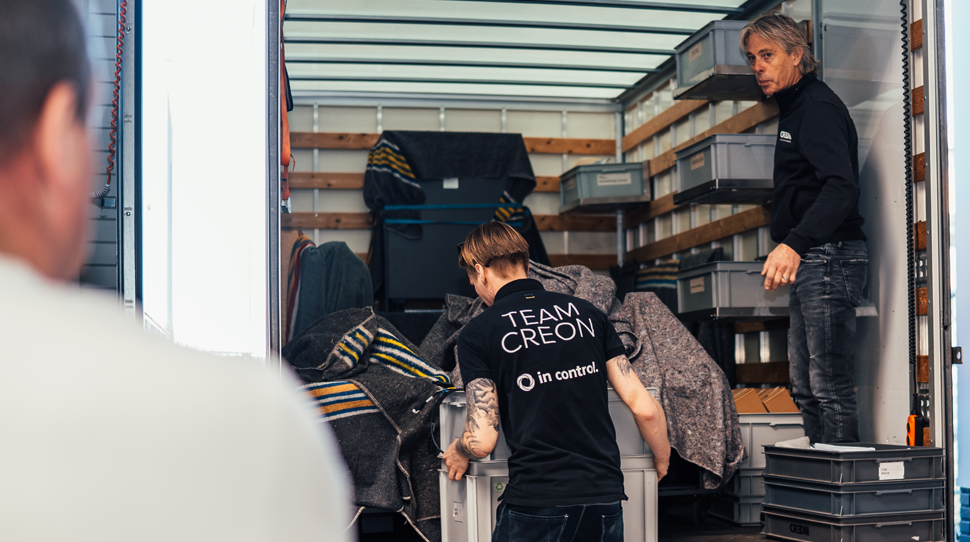
Transport is never an afterthought. Workstations are packaged as sustainably as possible. Where feasible, CREON uses blankets instead of plastic. Packaging materials from suppliers are reused. For international projects, custom transport crates are used, allowing complete workstations to be shipped safely and securely.
It may seem like a detail, but this is where the difference between delivering and handing over becomes clear.
A control room is rarely an empty space. Often operations continue, or conditions differ from what was expected in advance. “The first thing we do is check whether the space is safe and workable for us,” Van Dijk explains. “Then we mark out everything very precisely. Dimensions are crucial for how the workstations will function.”
If a space is not yet ready or circumstances differ from the plan, this is always discussed with the client. No assumptions. No rush. Just clear communication and control.
Once the workstations are installed in the control room, the final check follows. The technicians take the time to carefully go through everything. The workstations are cleaned and visually inspected for any damage or imperfections.
Together with the client, they walk through the control room. What is noticed is discussed. What needs to be resolved is resolved, unless the client explicitly indicates otherwise. This creates a transparent and careful handover moment.
For CREON, quality does not end when the control room goes live. Maintenance and service are essential for long term reliability. “Clients often do not notice early signs of wear or issues,” Van Dijk explains. “We do. By addressing them in time, you prevent bigger problems.”
During service visits, one question is always asked: Are you still happy with the workstation? That feedback is shared internally and used to improve or resolve issues structurally. Sometimes quality is also about small pieces of advice, such as using the sit stand function properly. Or simply the reminder: “Try standing now and then.”
Not when everything is technically correct. But when workstations operate reliably, users work comfortably and disruptions are avoided.
“When we receive a message afterwards saying people are satisfied with how we worked,” Terloo says, “we know it is right.” That is where in control becomes tangible at CREON. In calm, trust and continuity. In a workstation that does what it should do, without demanding attention.